Where did it all begin?
Jump into the way-back machine to 1906 when the first motorcycle time trials were held. The event was run by the Auto-Cycle Club and saw bikers racing up dirt tracks, trying to beat each other and their own personal times. This evolved into weekly 'hare scrambles', and in 1924 the first official event was held in Camberley, Surrey, UK. The sport soon became known as motocross, a portmanteau of motocyclette, the French word for motorcycle, and cross-country.
Rigid-framed street bikes were eventually swapped for ones with suspension in the early 1930s, with further developments – such as swinging rear fork suspension – following in the early '50s. Motocross boomed in the late 1950s with the introduction of the FIM Motocross World Championship in 1957.
Who were the early stars?
Now in its seventh decade, motocross has produced many great riders, including Belgian Joël Robert, hailed as one of the most talented riders of all time; Eric Geboers, the first man to win world championships in all three classes; and five-time motocross world champion Roger De Coster, known as “The Man”.
De Coster's fitness and control were so great that he was renowned for winning with authority. These early champions helped establish motocross as an international sport.
What are the major competitions?
The two big motocross championships, taking place on elaborate dirt tracks in the US and around the world, are the AMA Motocross Championship and the FIM Motocross World Championship. The AMA series has run since 1972, while the FIM series began as a European Championship in 1952.
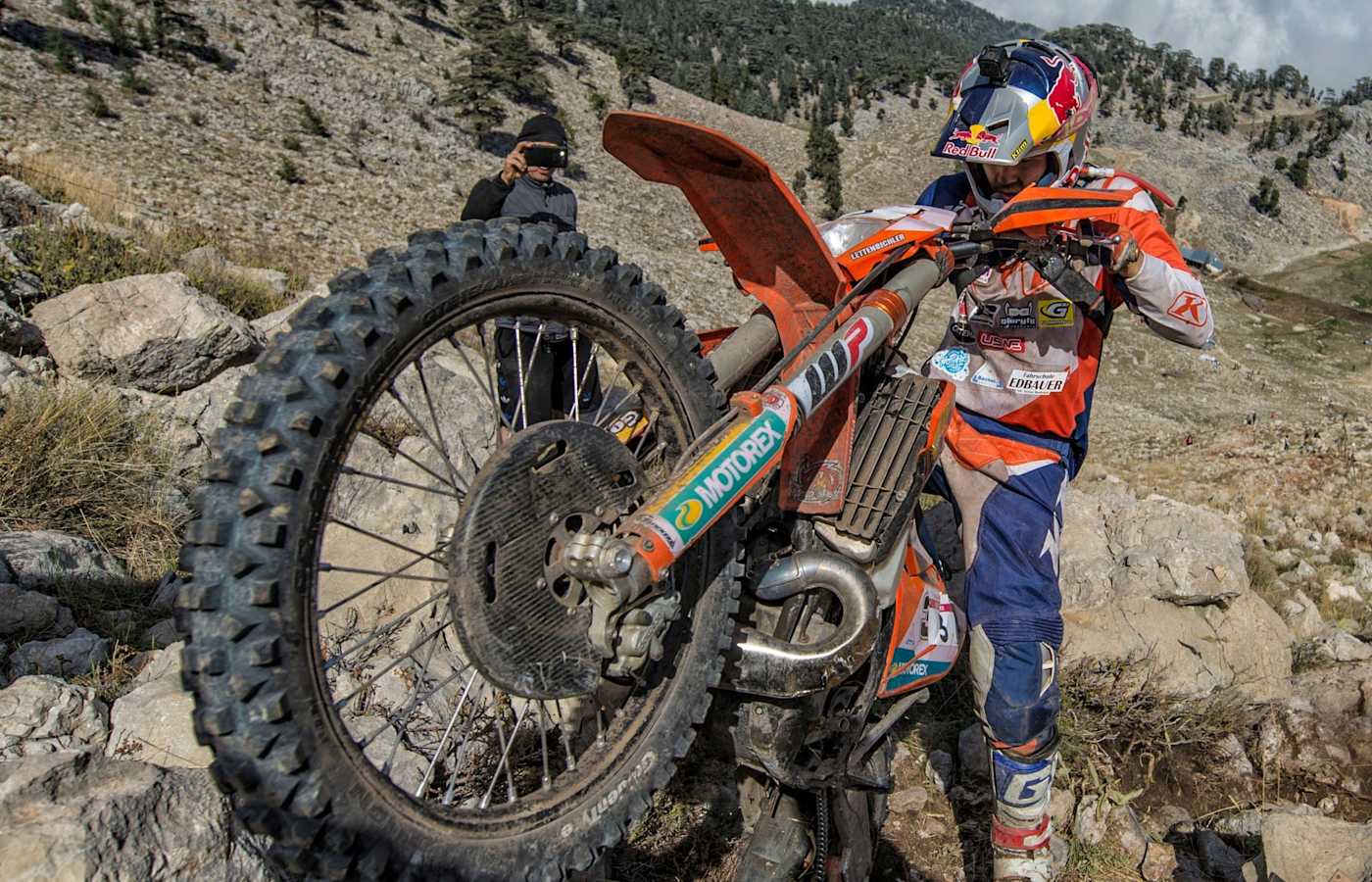
Both feature two classes of bikes – 450cc (MXGP) and 250cc (MX2). Sports that derived from motocross include Supercross, Freestyle, Big Air, Supermoto and Hard Enduro, each with its own track style and championship series.
Three formats compared
| FEATURE | SUPERCROSS (SX) | MOTOCROSS (MX) | SUPERMOTOCROSS (SMX) |
|---|---|---|---|
| Terrain | Man-made dirt in stadiums | Natural outdoor terrain | Hybrid: stadium + outdoor |
| Obstacles | Steep triples, whoops | Natural elevation, long jumps | High-speed technical mix |
| Season | Winter / spring | Summer | Post-season playoffs |
AMA Motocross & MXGP
The AMA Pro Motocross Championship is a US-based series, whereas the FIM Motocross World Championship holds events around the globe. The AMA series grew out of international exhibitions in the late 1960s, and its first recognised championship round was held at Road Atlanta in April 1972. MXGP runs across multiple continents, with most teams and events based in Europe.
AMA Supercross
Supercross is a stadium-based version of motocross. Large quantities of dirt are shaped into tight racecourses filled with jumps, bumps and rhythm sections. Riders need exceptional throttle control, timing, fitness and focus.
SuperMotocross World Championship
The SuperMotocross League combines AMA Supercross, AMA Motocross and post-season playoff rounds. The format began in 2023 to unify the SX and MX series and crown one ultimate champion.
What's the difference between the disciplines?
Motocross, Supercross, SuperMotocross, Freestyle, Big Air, Supermoto and Hard Enduro can all trace their genesis back to motocross. Many riders have competed in multiple disciplines, but each has its own character.
Motocross (MX)
Outdoor dirt tracks, often a mile or more in length. Riders race two motos, and course conditions deteriorate throughout the day.
Supercross (SX)
Off-road motorcycles on artificial dirt tracks, usually inside stadiums, with steep jumps and technical obstacles.
SuperMotocross (SMX)
A hybrid of Supercross and Motocross tracks, designed to combine speed with technical sections.
Freestyle (FMX) & Big Air
Performance disciplines judged on tricks, difficulty, execution and style. Big Air focuses on each rider's best jump.
Supermoto
Off-road motorcycles, often with slick tyres, racing over a mix of dirt, asphalt and flat-track-style surfaces.
Hard Enduro
Multi-stage events over demanding natural terrain such as forests, mountains and quarries.
Who are the riders?
Hall of famers such as 10-time world champ Stefan Everts, Joël Robert, Roger De Coster and Ricky Carmichael once ruled motocross. Today's stars continue to push the limits across the world's major series.
The 250 class is where emerging athletes prepare for a move into the 450 class. Rising names include Jo Shimoda, Tom Vialle, Julien Beaumer and Cole Davies.
What are the rules?
FIM Motocross World Championship and AMA Motocross events consist of two races, or motos, in each class. Points from both races are combined to crown an overall winner. Supercross uses heats and a points-paying Main Event, with race duration varying by class.
Classes: 250cc vs. 450cc
The 450 class is the premier division, featuring the sport's biggest stars. The 250 class is a developmental pathway in many championships, although riders can build long careers in the class. MX2 has an age-related progression rule, while AMA 250 racing does not use the same age limit.
The moto format and scoring
Motocross rewards consistency because riders race twice on the same day. In the points system described for the championship, a first-place finish earns 25 points, second earns 22 and third earns 20, with points decreasing for subsequent positions. The rider with the most points after both motos wins; ties are broken by the better second-moto finish.
Starting gates and the holeshot
Riders line up behind individual backward-falling gates. When the gates drop, the field accelerates down a straight that funnels into the first corner. The rider who reaches the holeshot line first earns the holeshot and the advantage of clear track ahead.
What exactly is a motocross bike?
Motocross bikes have developed from street bikes with knobby tyres into high-end, lightweight specialised machines. They come in different engine sizes depending on the competition, and professional bikes are rarely completely stock.
Compared with a standard dirt bike, a motocross machine may have narrower gear ratios for sharp turns and hard acceleration, stiffer suspension for large jumps and quick turns at speed, an aftermarket exhaust and many rider-specific parts.
250cc vs. 450cc comparison
| FEATURE | 250CC CLASS | 450CC CLASS |
|---|---|---|
| Engine type | 250cc four-stroke | 450cc four-stroke |
| Average horsepower | ~40–45 hp | ~55–65+ hp |
| Weight range | ~220–225 lbs | ~235–245 lbs |
| Riding style | High RPMs, momentum-driven | Throttle control, immense torque |
| Target audience | Rising stars, lighter riders | Elite pros, heavy hitters |
What is the terminology?
Every sport has phrases that can confuse a new fan. Here are a few terms to get your head around.
A symptom caused by gripping the handlebars tightly during a race, restricting blood flow and making the forearms throb.
When a rider overtakes before a corner and makes another rider slow down and lose momentum.
The surface of a jump facing the rider on approach.
The first rider to reach the painted line at the exit of the first turn.
The path a rider chooses through the track, often the quickest or most packed-down route.
Getting the bike sideways in a turn while accelerating.
Losing the front end when the front tyre loses traction.
Landing on the crown of a jump instead of its downslope, often costing momentum.
Dirt and rocks thrown from the rear tyre after twisting the throttle.
A series of evenly spaced bumps that riders skim across or jump through.
Leaning the bike sideways up a jump face to keep the flight lower and faster.
The 2026 major events calendar
The SuperMotocross World Championship includes the AMA Supercross and AMA Motocross seasons plus post-season playoff rounds. International fans can follow the FIM Motocross World Championship through its official streaming service.
AMA Motocross Championship — an 11-round championship with 22 points-paying motos at iconic American motocross facilities.
FIM Motocross World Championship (MXGP) — an international series visiting five to six continents across 18–20 events.
Motocross of Nations (MXoN) — a team event where countries send three riders to compete across three classes.
SuperMotocross World Championship Playoffs — three consecutive post-season rounds on hybrid courses combining key elements of SX and MX tracks.
Where to watch — US SuperMotocross coverage is available through NBC networks and Peacock; international MXGP coverage is available through MXGP-TV. Availability varies by territory.